

Working Group
“The Activated Museum: Practices of Collecting in an Age of Exhibitions”
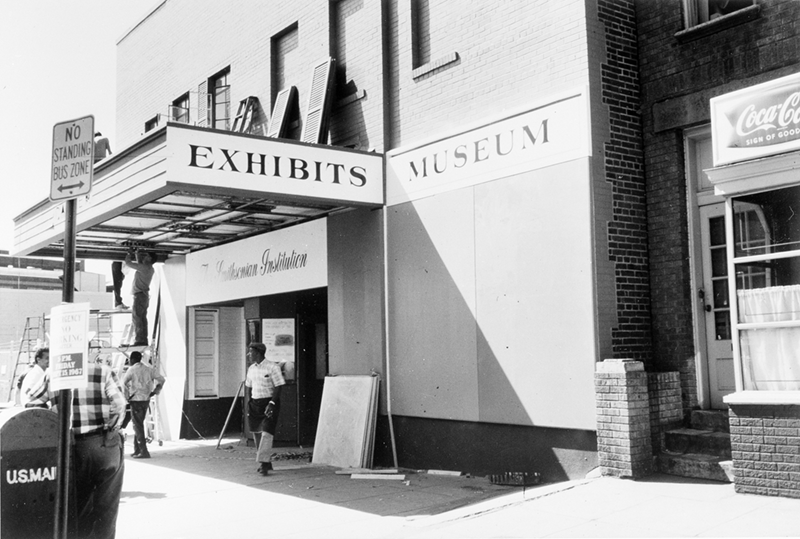
Credit: Smithsonian Institution Archives, 90-13510 (public domain).
This working group investigates the emergence of the “new museum,” starting in the 1960s, as a site of the reconfiguration of humanities practices. Museums had long been a social space where humanities scholars from different backgrounds––history, philology, art history, anthropology––applied their knowledge and practices. During the global Cold War, the classic landscape of museums began to seem fusty and outdated, especially when contrasted to the new, big exhibitions with their popular-culture themes and configurations. In different parts of the world, the concept emerged of a new museum that could respond to the era’s economic and political needs, building on insights from different humanities disciplines. That included what we call “activated museums”: future museums, nonaligned museums, ecomuseums, community, pan-global, solidarity, or anticolonial museums, and museums-in-exile.
All these projects focused on a particular neighborhood, country, region, or multilateral network and were politically anchored outside the Cold War polarities, seeking to connect to international cultural and scientific diplomacy. Their concern was less to institutionalize the museum than to revitalize its concept and format, imbuing it with new cultural and political relevance or activating that relevance where it already existed. At the same time, the new forms shared a common problem: how to build an institution based on ideas rather than collections. How could the present be collected and visually spatialized? New “objects” such as oral sources or intangible heritage became relevant, had to be classified, and were incorporated into a “new” collection. How could (or should) the activated museum, despite its vitality and future-orientation, build on the stasis of collections?
Our working group argues that a poetics and politics of collecting as practice was constitutive of these various museums; in turn, the museums’ history sheds new light on collecting practices in the twentieth century. Through this inquiry, we hope to contribute to research on the historical and contemporary sociopolitical significance of museums as venues of applied humanities.
-
Workshop “The Activated Museum: Practices of Collecting in an Age of Exhibitions”
(HU Berlin, April 10–11, 2026) (PDF) -
tba
-
For further information, please contact Niki Rhyner.